“Science is never settled.” Speaking on LBC Radio yesterday, the Reform MP Nigel Farage used this phrase to deflect criticism of Donald Trump’s inaccurate claim that paracetamol use in pregnancy may cause autism:
That’s an opinion he’s got. It’s not one that I necessarily share. But I mean, honestly, I’ve no idea… I don’t side with anybody because science is never settled, and we should remember that.
It’s a pithy phrase, one that seems to gesture towards the spirit of debate and criticism within science. It even sounds a bit like something a historian of science might say. After all, our job is to chart the ways in which different kinds of knowledge have been contested in the past. We write books with titles like Never Pure or We Have Never Been Modern. In certain ways, the central message of the history of science is that “science is never settled”.
But where did this phrase actually come from?
Denial and Delusion
As far as I can tell, the phrase “science is never settled” has its origins in the mid-2000s with a group of climate change denialists.
In the run-up to the 2007 Intergovernmental Panel on Climate Change (IPCC) report, this stock phrase was introduced by lobbyists and fringe scientists in an attempt to tie right-wing political agendas to the idea of free scientific debate.
Speaking before the United States Senate Committee on Environment and Public Works in December 2006, the palaeontologist Robert M. Carter used this phrase as part of his criticism of what he called “the alarmist activities of the IPCC”:
Science is about facts, experiments and testing hypotheses, not consensus; and science is never ‘settled’
Carter quickly became famous for his denial of the severity of anthropogenic climate change. He essentially argued that the public had been duped by what he called “a propaganda campaign”.
He even singled out the then-Governor of California, Arnold Schwarzenegger, for his apparently blind acceptance of the IPCC’s conclusions. “The Governor is deluding himself because the science of climate change has never been more uncertain,” argued Carter.
Anti-Climate Consensus
Robert M. Carter might have been on the fringe, but he wasn’t alone. He was in fact part of a broader campaign led by what Erik M. Conway and Naomi Oreskes have called “merchants of doubt”. And these people weren’t just selling climate change denial, they were also selling a particular vision of society.
Carter himself made this explicit in his statement to the United States Congress. Immediately after having used the phrase “science is never settled”, Carter—seemingly out of nowhere—begins to quote the former British Prime Minister Margaret Thatcher:
As Margaret Thatcher famously observed, ‘Consensus is the process of abandoning all beliefs, principles, values and policies in search of something in which no one believes, but to which no one objects; the process of avoiding the very issues that have to be solved, merely because you cannot (otherwise) get agreement on the way ahead.’
For Thatcher, a free society was one in which there was no possibility of consensus, in which no view was properly settled. Indeed, according to Thatcher, there was famously really “no such thing as society”. For Carter, the same was true of science. There was no such thing as society. And there was no such thing as global warming.
A few months later, Carter wrote an article for The Australian national newspaper titled “It’s Good Sense to Avoid Consensus on Global Warming”. In it, he repeated many of the lines from his appearance before the United States Congress, albeit with a bit more bravado:
Science is never settled, and it is about hypothesis testing against known facts, not arm-waving about imaginary futures that have been created by PlayStation 4 computer buffs. Consensus nonsensus.
Carter, who was clearly not a fan of computer games (another bug-bear of the right at the time), was beginning his own “propaganda campaign” against the “climate consensus”.
The phrase “science is never settled” continued to pop up throughout the 2000s and 2010s, most often linked to climate change denial, although sometimes extending to anti-vaccination and the broader right-wing campaign against “experts”. Today, there’s even a dedicated website (www.scienceisneversettled.com) with a banner at the top inviting people to “Click here to check out why greenhouse-warming theory is physically impossible”. (I wouldn’t bother.)
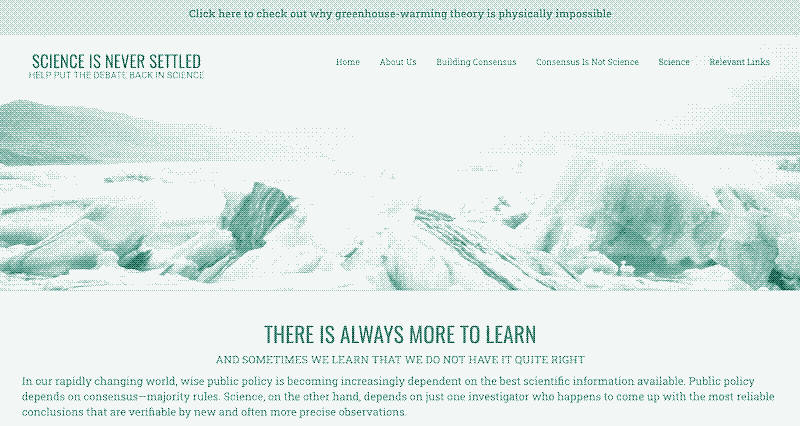
“Click here to check out why greenhouse-warming theory is physically impossible”, www.scienceisneversettled.com
Farage’s use of the phrase “science is never settled” is therefore unlikely to be have been an accident. Indeed, he probably learned it from the Deputy Leader of Reform, Richard Tice, who in 2022 was already using the line to defend his position on climate change.
Science Without Trust
The Latin motto of the Royal Society, Britain’s oldest scientific society, is “Nullius in verba”, or “Take nobody’s word for it”. It’s a reasonable starting point for any kind of evidence-based enquiry. But you can’t do science—and you can’t build a society—without some level of trust.
Your average citizen, me included, doesn’t accept climate change or vaccine efficacy because they’ve personally gone through the data. They accept these things because they have some level of trust in the institutions which produced that knowledge.
And that’s the crux of the problem. We live in an age in which trust no longer functions in society. People do not trust the IPCC, or the government, or the media, or scientists.
That’s partly the fault of individuals like Margaret Thatcher and Robert M. Carter for promoting the idea that consensus is the enemy of freedom. But it’s also the fault of an entire political and intellectual class for failing to take the legitimate concerns of many people seriously, for blithely expecting trust without delivering meaningful change.
When we hear the phrase “science is never settled” today we should therefore be wary. Rather than questioning whether science is “settled” or not, we should instead focus more on how trust is generated in society.
Attempts to undermine public trust in science are part of a broader political agenda to undermine public trust in society as a whole. The challenge now is to rebuild that trust in both science and society.