In 1984, one of the most famous historians of the twentieth century appeared in a computer game.
The game was called Deus Ex Machina and the historian was the Marxist peace campaigner E. P. Thompson, author of The Making of the English Working Class (1963).
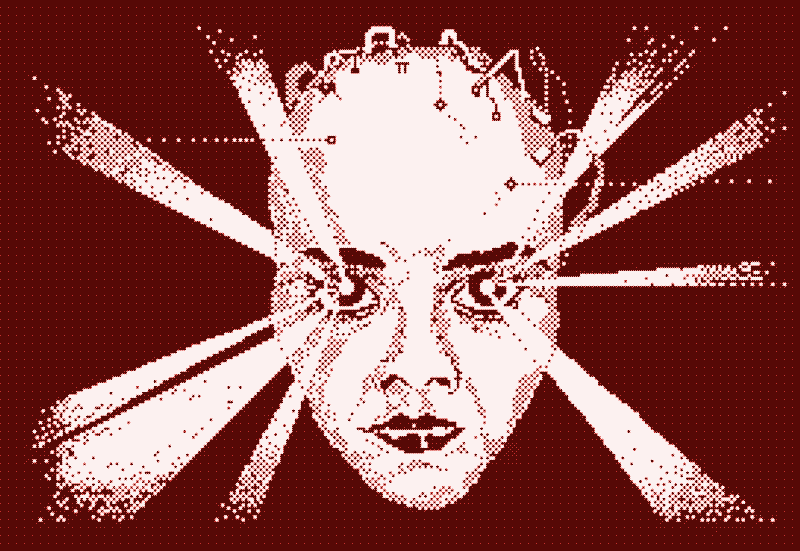
Loading screen for Deus Ex Machina (1984) on the ZX Spectrum.
Like many historians, I first read Thompson as an undergraduate. And I still use his “Time, Work-Discipline, and Industrial Capitalism” article in my teaching. Now, I’m by no means a world expert on Thompson. But I have read all his major works, including the somewhat obscure Alien Homage, Thompson’s biographical account of his missionary father in colonial India.
I was not, however, aware that Thompson featured in a 1980s radical art game made for the ZX Spectrum. Not until I came across a copy of Deus Ex Machina whilst browsing ZX Spectrum cassettes on eBay. The game looked cool, so I looked it up. And there, in the credits, I was intrigued to see “E. P. Thompson” listed.
At last, I thought, all my interests had finally converged—radical history, old technology, and computer games.
Deus Ex Machina
As it turns out, Deus Ex Machina has a bit of a cult following amongst aficionados of 1980s gaming. It was the fever dream of architect-turned-game-designer Mel Croucher. It is hard to convey exactly how weird the game is, and how original it was for the time, and frankly still is. If you have a spare 48 minutes, I highly recommend watching a play-through on YouTube. Or, better yet, you can actually buy a copy and play it on a modern computer via Steam.
The game follows the life of a single human—from conception to death—in a dystopian future (that is, 1994). In this future, the United Kingdom is governed by the “Machine” which manages “defence and internal security” as well as “all passport, communications and censorship operations”. In the game, you—the player—are an anomaly. You weren’t meant to be born. You are in fact the result of a freak accident. At the beginning of the game, the “last mouse on Earth” crawls inside the “Machine” and does a shit. I kid you not. Somehow, this mouse shit causes a DNA mutation and the fertilisation of an embryo. You then play through various “ages of man”, including a sequence in which you tumble across a strobe-lit screen as a foetus, all whilst trying to avoid the “Defect Police”.

Sequence from Deus Ex Machina (1984) in which the player controls their own foetus.
It’s a work of art for sure. But the really clever thing is that the game was accompanied by a separate audio cassette. At the time, audio in computer games was very rudimentary—the ZX Spectrum had a single channel beeper. You couldn’t record vocals or a guitar. You could just beep across a few octaves.
Croucher, however, had the brilliant idea to separately record the audio and ask the player to put the cassette on at the same time. There’s even a countdown at the start to get everything in sync. And again half way through to switch over to the other side of the tape.
For the vocals, Croucher managed to recruit a few famous names. The comedian Frankie Howerd (Carry on Doctor) voiced “The Defect Police”, John Pertwee (Doctor Who) voiced “The Storyteller”, and none other than English punk legend Ian Dury (Blockheads) voiced “The Fertiliser”.
And E. P. Thompson. He was “The Voice of Reason”.
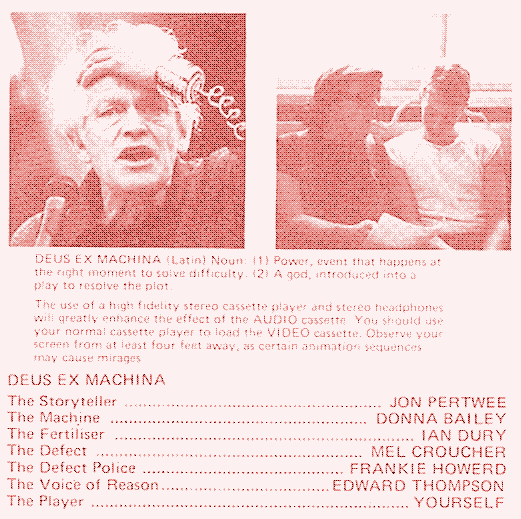
Credit for “Edward Thompson” in Deus Ex Machina (1984).
Games for Peace
At its core, Deus Ex Machina is a critique of technocracy, autocracy, and violence. Mel Croucher himself was involved in anti-nuclear campaigns. He made games in which the player has to avoid violence, or is the victim of violence, rather than the perpetrator. “If that all sounds like I’m an airy fairy pacifist, stuck up my own arse, that’s because I’m an airy-fairy pacifist, stuck up my own arse,” declared Croucher in a developer commentary produced for the game’s 30th anniversary.
It was this connection to the peace movement, and the Campaign for Nuclear Disarmament in particular, that brought E. P. Thompson into the world of radical computer games. As Croucher later recalled:
He [E. P. Thompson] had been invited to address our local campaign for nuclear disarmament, and my role was to record his speech because I had some professional recording gear. When I explained what I was trying to do with Deus Ex Machina he simply tossed his grey lion’s mane and said, “where do I sign”.
The speech that Croucher recorded that day then ended up in the game: “[It] cost me nothing at all, apart from the hour and a half I spent discussing propaganda and freedom of speech with the greatest peace campaigner of the age, E. P Thompson.” Croucher later spoke about the encounter, fondly recalling:
He was an optimist. I thought at the time we were about to tip over the brink and start lobbing Trident missiles at one another. E. P. Thompson would have none of it. He was confident that walls would be breached and barbed wire would be cut.
Thompson’s words, cut between the hypnotic singing of the “Machine” and a dirty bass line, ring out as the player enters the fifth age of man—an overweight figure stomps down the street, and the player must decide whether to crush “Hate” and “Lies” or “Life”, “Love”, and “Peace” as barbed wire slowly moves up and down the screen.

Sequence from Deus Ex Machina (1984) featuring E. P. Thompson’s speech.
Appropriately, the speech itself addresses the very themes of Deus Ex Machina. Thompson talks about telephone tapping, the security industry, as well as the emancipatory power of music. I recently made a transcript:
I think it’s the very sense that the ground is moving under their feet—and the ground is us—that has made the political leaders, who feel unstable and uncertain in new ways, so determined to impose their strategies upon an increasingly reluctant people.
The security presence extends in different ways on both sides. Police, telephone tappers, the growth industries—you know, the only real growth industries now are things like telephone tapping.
I’m so stupid. I hadn’t been reading the NME. I recently started reading the New Musical Express and I find out that bands are going backwards and forwards all the time. Anyway, they are going forwards—our British bands are going to the GDR and Poland and so on. A lot of these are peace bands. And you begin to find that there’s already a huge movement of “Rock Across the Blocs” if you like.
The healing process is going on. Despite what the politicians, despite what the militarists think, the healing process is going on. And it’s something which we can contribute to by our solidarity, by extending this knowledge… Thank you.
Audio of E. P. Thompson in Deus Ex Machina (1984). Compressed to 180 KB.
For me, Deus Ex Machina is a reminder of a different kind of computer game, one with a different purpose. In the 1980s, computer games could be political. They could be punk. They could be art.
Today, that hasn’t been completely lost. Games like Citizen Sleeper and Disco Elysium are great examples of computer games as political art. And both address themes of technology and violence.
At a time when the computer games industry is in financial turmoil, when a game is just another investment opportunity, an asset class, we need more games like Deus Ex Machina, and more historians willing to engage with them.