I still remember the first time I played a computer game. It must have been about 1995. My uncle brought round his Apple Macintosh and loaded up Wolfenstein 3D on floppy disk.
I was, perhaps, a bit too young. But I was entranced as my uncle glided through the castle, uncovering secret passages, shooting Nazis, and putting the boot, often quite literally, to fascism. Then I had a go. I was hooked. From that moment on, I wanted nothing more than to play computer games. I wanted to make them too, so much so that by the time I was a teenager, I was set on doing a degree in computer science.
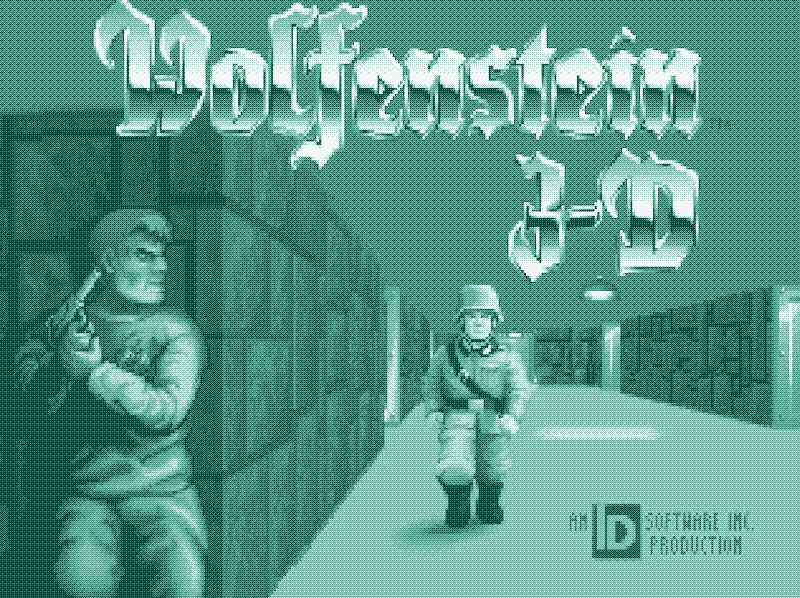
A screenshot of Wolfenstein 3D, running on my MacBook Pro via RetroArch.
Things didn’t quite turn out the way I imagined. I did start a computer science degree, and I still play games, but I ended up becoming a historian of science and technology.
In the end, these things weren’t so unrelated. Recently, I’ve been thinking a lot about the relationship between computer games and the history of machine learning, or “artificial intelligence” as it is now marketed.
Ultimately, I think that recognising the origins of artificial intelligence in the world of computer games is absolutely key for getting a handle on this new technology.
From Bullfrog to DeepMind
I’ve never met the co-founder of DeepMind, Sir Demis Hassabis. But from what I can tell, he seems like a sound guy, the opposite of a Silicon Valley tech bro. It’s also clear that he too loves games.
“I actually got into AI through games,” explained Hassabis in a recent documentary, The Thinking Game, which I highly recommend.
Hassabis, something of a child prodigy, started off with boardgames, then went onto chess, before entering the world of computer games. After getting an offer to study computer science at Cambridge, Hassabis took a gap year—because he was too young to go to university. He ended up, aged 17, working for Bullfrog, the games company, helping make the classic Theme Park. Later, after university, he went back to computer games, working for a bit at Lionhead Studios on Black & White.
(As it happens, I too briefly worked at Lionhead, where I did an internship around the release of Black & White 2. I also went to Cambridge to study computer science. I did not, however, go on to win a Nobel Prize. Nor am I very good at chess.)
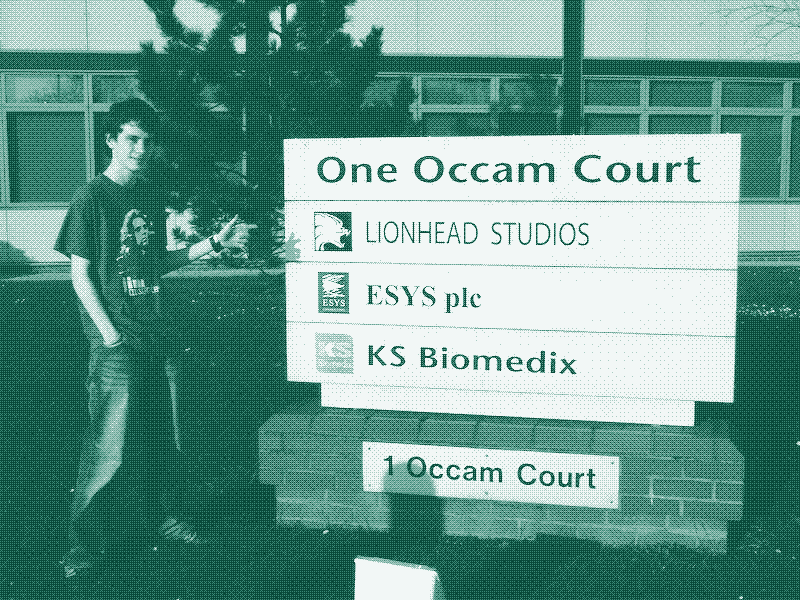
The author, aged 16, outside Lionhead Studios, Guildford.
This overlap between games and artificial intelligence is important. When Hassabis co-founded DeepMind, his team initially worked on getting a computer to learn to play various games, starting with something easy like Pong, before moving on to Breakout and Space Invaders. The key to this was letting the computer work out the rules and how best to respond on its own, through reinforcement learning.
Hassabis clearly had an intuitive sense that a lot of what humans do—what we call “intelligence”—is actually just playing games. Once you realise that, you can treat something like protein folding, or predicting the weather, as a kind of game. And you can use the same methods for learning to play Pong to predict the structure of 200 million proteins, for which Hassabis was jointly awarded the Nobel Prize in Chemistry.
Listening to Hassabis speak, you get a sense of fun being at the heart of a lot of this. Recalling his time working at Bullfrog, Hassabis described “a feeling of how much fun that was, to invent things every day.” And when chess became more like a job, when it stopped being fun, he gave it up.
Why Fascists Hate Games
This focus on fun and games is important. It gives me some hope for the future of artificial intelligence. And I think it provides a way to distinguish between the valuable and the vacuous when it comes to AI today.
Hassabis wasn’t the first to see something transformative in the power of games. Throughout the twentieth century, historians, psychologists, philosophers, and anthropologists made the case that play was really at the heart of culture. It was part of what it meant to be human.
The whole field of child psychology emerged from this, with pioneers such as Melanie Klein and Donald Winnicott exploring the working of the human mind through watching children play. Similarly, Ludwig Wittgenstein centred his later philosophy on the idea that language was just another game, like any other.
Out of everyone, the early twentieth-century Dutch historian Johan Huizinga made the strongest case for the importance of play in his brilliant book Homo Ludens: A Study of the Play Element in Culture (1938). For Huizinga, play was at the core of all human activity—even the really serious stuff. It was what made ideas, even culture itself, possible.
Huizinga lived at a time of rising fascism in Europe. Shortly after writing Homo Ludens, the Netherlands was invaded by Nazi Germany. Huizinga was later arrested by the Nazis and banned from his teaching position at Leiden University.
I don’t think it’s a coincidence that, amidst the rise of authoritarian regimes, Huizinga chose to write about play. As he pointed out, play—like culture—requires a level of freedom. You can’t play a game with a gun pointed to your head. It’s not a game anymore. It’s not fun. And if there’s one thing that fascists really hate, it’s fun.
That’s why Charlie Chaplin’s The Great Dictator is such a powerful takedown of fascism. And to return to computer games, that’s why Wolfenstein 3D has much the same effect. It’s a playful critique of fascism. The medium really is the message here.
Are You Still Having Fun?
Today, it’s hard to know what to think of AI. On the one hand, there is genuine potential to do good, with artificial intelligence solving problems like protein folding, improving climate models, and identifying new materials. Yet on the other hand, there is a sense of the dangers of artificial intelligence, ranging from the industrial production of false information to the automation of war.
My argument is that thinking in terms of fun and games provides a starting point for distinguishing the good from the bad. The criteria is this:
The use of artificial intelligence is likely to have a positive effect on society if it is used to solve a problem that, on a smaller scale, a human might think of as an enjoyable game.
This might seem counterintuitive at first. Surely we want AI to solve the problems that are no fun at all? Don’t we want it to do the boring stuff?
It’s important here to distinguish between traditional computer programming and machine learning. Computers absolutely should be used to do things that are tedious. In an ideal world, they should free us from doing repetitive tasks. That’s exactly what traditional computer programming is for—or, to be more specific, that’s what declarative programming is all about.
But machine learning, and functional programming, is different. It’s not there to do tedious repetitive tasks. Instead, machine learning is good at solving really complex problems that are more like games.
That’s why I think much of what Hassabis did with DeepMind in its early years has been genuinely positive for society. AlphaFold fits my criteria perfectly. Protein solving is a game. It’s a game that, on a smaller scale, is fun for a human to solve. Machine learning takes that fun game, and scales it up massively, producing a positive effect.
At the other end of the spectrum, we have a repetitive task like writing an email or summarising meeting notes. These are not games. They are definitely not fun. For this very reason, using artificial intelligence to do these tasks is not likely to have a positive effect on society.
Unfortunately, as it stands, most of the time and money is going into uses of artificial intelligence that fail to meet my criteria. Large technology companies like Microsoft and OpenAI want us all to use AI to do repetitive mundane tasks, like writing an email. Even Google, which now owns DeepMind, is headed in that direction.
In contrast, I believe that a more positive future for artificial intelligence relies on recognising what Johan Huizinga called “the play element in culture”. After all, if it’s not fun, what’s the point?