“Big Tech” is big money. Nine out of the ten most valuable companies in the world, as measured by market capitalisation, are technology companies. The top five—Nvidia, Alphabet (Google), Apple, Microsoft, and Amazon—are all routinely described as technology companies.
| Rank | Company | Market Cap |
|---|---|---|
| 1 | NVIDIA | £3.586 T |
| 2 | Alphabet (Google) | £3.158 T |
| 3 | Apple | £3.057 T |
| 4 | Microsoft | £1.982 T |
| 5 | Amazon | £1.847 T |
| 6 | TSMC | £1.706 T |
| 7 | SpaceX | £1.524 T |
| 8 | Broadcom | £1.363 T |
| 9 | Saudi Aramco | £1.273 T |
| 10 | Samsung | £1.097 T |
Top ten companies by market capitalisation on 26 June 2026. Source: companiesmarketcap.com
From a history of technology perspective, there’s something a bit odd about all this. The global economy is dominated by technology companies, yet most of these companies don’t actually make anything. They’re almost all software companies.
Out of the top five, Nvidia is the only technology company focused mainly on hardware. But even then, Nvidia needs someone else to actually manufacture its graphics cards, as they don’t design or build their own fabrication facilities. That is done by Taiwan Semiconductor Manufacturing Corporation (TSMC) and Samsung.
Apple, of course, also sells a lot of hardware—iPhones and MacBooks and alike. But again, Apple is even more reliant on actual hardware companies, such as Samsung and ARM, to provide the core architecture and manufacturing capability. In reality, Apple’s business is a software business. They develop what they market as fantastic software—iOS and MacOS—and then tie that software to hardware sold with a big markup. These days, Apple is also all in on the “software as a service” model, selling music and video streams alongside access to professional editing suites.
At first glance, Amazon is a bit different. Still, whatever it is, Amazon certainly isn’t a hardware company. (Sorry, the Kindle doesn’t count.) From a consumer perspective, Amazon is just a big online shop. But really, this is just another tech company built around software. The basic software is the website itself, and then on top of that Amazon sells various services, such as music and video streaming. In addition, Amazon’s main business these days is actually selling cloud computing, which again, is really just software managing access to data centres.
The remaining two in the top five are even more obviously software companies. Microsoft and Google might sell a few computers and phones, but their core business is software, whether an operating system or a search engine. Increasingly, they too sell this software as service, as with Microsoft 365.
Of course, all these companies buy hardware. Microsoft, Google, Amazon and Apple all spend enormous amounts on data centres. They certainly invest in infrastructure, just not manufacturing. But that doesn’t make them technology companies any more than a supermarket or a farm is a technology company because it buys a till or a tractor.
Hardware vs. Software
Why then do we refer to software companies as technology companies? And when did this start to happen? To answer these questions, we need to look back to the history of computing and the origin of the hardware vs. software distinction.
Famously, prior to the widespread use of electronic computers, this was a division of labour between real people. The division was typically gendered. Mathematicians, often men, decided what calculations needed to be done. Computers, often women, performed those calculations to get the results.

Human computers at Harvard University performing calculations for the astronomical observatory in 1892. At this time, women could not study for a degree at Harvard. Source: Wikimedia.
In the early nineteenth century, as the industrial revolution got underway, people started to wonder if this division of labour could be reproduced in a machine. Computers at this time were therefore mechanical. In the 1820s, the English mathematician Charles Babbage designed what he called a “Difference Engine” to calculate polynomial functions. To input the function, you had to set the mechanical wheels.
This was really just a fancy calculator, but Babbage followed it up with a design for what became known as the “Analytical Engine”. This was a general purpose computer—it could perform different operations depending on instructions input by the user—but it was still mechanical. Tellingly, Babbage used the language of the industrial economy to describe the storage and processing of data. There was a ‘store’ (where the data was held) and a ‘mill’ (where the data was processed).
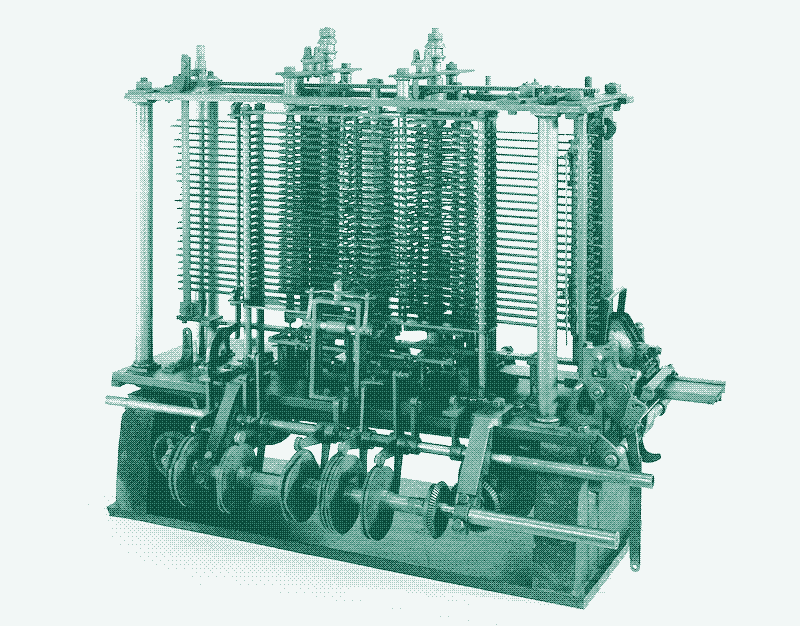
Part of prototype of Charles Babbage’s “Analytical Engine”, Science Museum, London. Source: Wikimedia.
Babbage only got to the prototype stage. Some similar machines were built in the nineteenth century, but it was really only in the twentieth century that general purpose computing became a reality. In 1941, the German engineer Konrad Zuse built an electromechanical computer, the Z3, which was quickly co-opted into the Nazi war effort. Around the same time, a group of British codebreakers at Bletchley Park built an electronic computer, known as Colossus. It was run using a combination of paper tape input and electronic switches. Following the Second World War, engineers built similar electronic computing machines, such as the Manchester Baby. Crucially, these new machines could actually store programs in memory—in the case of the Manchester Baby, exactly 1024 bits stored via charges in a cathode-ray tube.
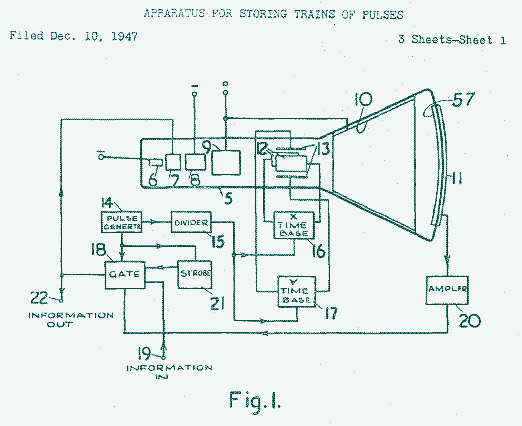
1947 patent for “apparatus for storing trains of pulses”, a kind of cathode-ray tube adapted to serve as computer memory. Source: Wikimedia.
From the Analytical Engine in the nineteenth century to the Manchester Baby in the twentieth century, the computer as we know it was defined in terms of this division between the stored program and the processing of instructions. It was a division that mirrored a particular industrial world—between male managers and female workers—the ‘store’ and the ‘mill’ as Babbage put it.
In 1958, the American computer scientist John Wilder Tukey first used the terms “software” and “hardware” to describe this division. As he put it:
Today the ‘software’ comprising the carefully planned interpretive routines, compilers, and other aspects of automative programming are at least as important to the modern electronic calculator as its ‘hardware’ of tubes, transistors, wires, tapes and the like.
Over the next forty years, software was to completely overtake the importance of hardware in the business of computing.
Deindustrialisation and Big Tech
The modern computer was born out of a world of industrialisation. The rise of technology as software, on the other hand, was a product of deindustrialisation.
At exactly the same time that countries in Western Europe and North America began to move away from manufacturing, the software industry emerged to serve a new market. The economies of countries like Britain and the United States, rather than selling manufactured goods, began selling services. This new service economy—accountancy, consultancy, legal arbitration, insurance, index funds, and alike—demanded software. The most successful “technology” companies of the 1980s and 1990s were those that sold, not the hardware, but the operating systems and databases—companies like Microsoft and Oracle.

“Hardcore Software”, a 1987 job advertisement posted by Microsoft. Source: Vintage Computing and Gaming.
As deindustrialisation continued apace, software grew and grew. If you couldn’t sell actual stuff, then you needed to sell a service, preferably one that required little to no capital investment. Music, films, sport, shopping, and more besides. All these, it turned out, could be sold as software services.
With the rise of artificial intelligence, things have even gone to the next order of abstraction. It all gets a bit meta. After all, one of the main uses of artificial intelligence (which is sold as a software service) is to code more software (which can then be sold as a service). We’re living in an economy where we invite people to sign up for a subscription to ChatGPT in order to vibe code a health app to sell as a subscription to iPhone users.
Technocracy Inc.
If all this sounds like a really depressing pyramid scheme which might be financially unsustainable, that’s because… it is!
“Big Tech” companies are worth trillions of dollars. But they make nothing. If the Internet went down tomorrow, and never came back up, the financial value of the world’s biggest technology companies would be worth close to zero. That is unlikely to happen, but economies cannot be sustained on software—or hot air—alone. That’s something that countries like Britain and the United States are having to wrestle with at this very moment, as they wake up to ruinous effects of deindustrialisation.
I think things will change, although not necessarily for the better. Financial markets are starting to realise the need for some kind of manufacturing base as the core of an economy. Notably, Elon Musk became the world’s first trillionaire by leaning into manufacturing. SpaceX and Tesla make things. The value of other hardware companies like TSMC, Broadcom, Samsung, and AMD have similarly increased in value.
The problem here is that governments have been to slow to catch up. The state no longer has any say over the manufacturing base. That’s a problem when the state itself relies on manufacturing, not just for generating tax revenues and jobs, but for the stable functioning of government. That’s precisely why SpaceX is worth so much—because it has a monopoly on satellite technology that governments need. It’s why we’ve seen similar big investment in private military technology companies.
As we pivot back to hardware, economies will move from “software as a service” to what media scholars call “sovereignty as a service”. As it turns out, a government without technology is not really a government at all.