We’re living through a new “industrial revolution”. At least, that’s what companies like Nvidia and Microsoft would have us believe.
Earlier in the week, Microsoft confirmed a $30 billion investment in AI infrastructure in the UK. In making the announcement, Microsoft CEO Satya Nadella turned to history:
Right here in the UK, more than two centuries ago, the Industrial Revolution was born. The question now is: Can we do it again? Can we harness the power of AI to spark profound impact around the world?
This is all part of a broader trend, as tech companies increasingly turn to the “industrial revolution” in order to market themselves. Google DeepMind has similarly promised a technological leap “10 times bigger than the Industrial Revolution”.
Nvidia, which will manufacture the “more than 23,000” GPUs for a new UK supercomputer, made a similar pitch a few days later, posting a video titled “The UK’s Next Industrial Revolution”.
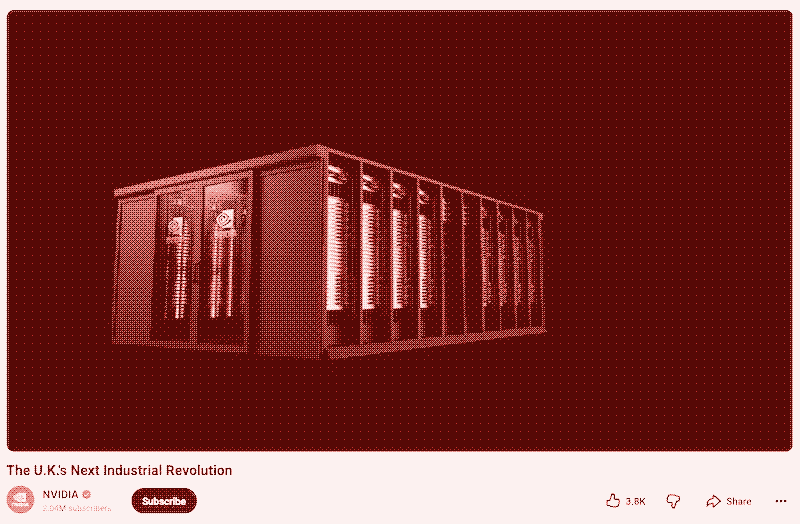
“The U.K.’s Next Industrial Revolution”, Nvidia, YouTube.
Over a couple of minutes, Nvidia delivers a potted history of scientific and technological development, from the steam engine through to the computer. The voiceover—I assume AI generated—gives us a similar history lesson:
Here, in the UK, began the revolution that shaped our modern world. And here it begins again.
We’re then invited to imagine an “AI revolution, with a new kind of factory, powered by Nvidia”.
As an advert for AI, the video was pretty lacklustre, cutting between various awkwardly animated engravings and photographs. It’s a strange combination of amateur and uncanny.
History for Tech Bros
I’m not sure where the tech companies learned their history. Perhaps the marketing departments asked CoPilot. In any case, as a historian of technology—and someone who every year gives the introductory lectures on the industrial revolution to over 300 undergraduates—I found the announcements fascinating and worrying in equal measure.
AI is probably bringing about another industrial revolution, but not the kind that Microsoft and Nvidia are thinking about. All these companies have a rose-tinted vision of the industrial revolution, one that few historians would recognise today.
As my undergraduates all know, the industrial revolution was not simply a product of technological innovation, nor is it a story just about Britain.
Here’s an essay question I sometimes set my students: “What kind of revolution was the Industrial Revolution?”. I like it because it’s open-ended. Students take it in all kinds of directions.
Let’s have a go at answering it and see what was missing from Nvidia’s version of the industrial revolution.
The Industrial Revolution was… the theft of skill
Prior to the nineteenth century, most manual workers in Britain understood their skill as a kind of property. That’s why they had things like guilds and apprenticeships. As a group of workers put it in 1823:
The weaver’s qualifications may be considered as his property and support. It is as real property to him as buildings and lands are to others. Like them, his qualification costs time, application and money.
Today, saying that a “skill”—like weaving—could be a kind of “property” sounds weird. But that’s only because of the success of nineteenth-century industrialists in convincing us otherwise. For many workers in the nineteenth century, new technologies were little more than the theft of their property.
The Industrial Revolution was… not a productivity revolution
Historians in the mid twentieth century used to think that the industrial revolution produced an enormous increase in productivity. Then, by the 1980s, they weren’t so sure. Yes, there was certainly an increase in productivity, but not at the kind of speed or scale previously thought. And even then, the real productivity gains were only in a small number of very particular sectors.
Still, the idea was the same—new technologies made work more efficient. And it was this increased efficiency which produced the increase in productivity.
That also turned out to be a bit more complicated. In fact, economic growth during the nineteenth century also depended on increases in working hours and the total working population.
After all, if you want to increase total productivity, you can just send more people to work. And if you want to increase per capita productivity, you can just get people to work longer hours.
Yes, of course a steam-powered spinning machine is more efficient in terms of input and output. But—and this is important—a factory of spinning machines also forced people to work harder over longer hours. Machines don’t stop. And neither did the workers operating them.
The Industrial Revolution was… dependent on slavery
The modern steam-engine was invented in Britain. And the factories which powered the industrial revolution were in places like Manchester and Glasgow. But no serious historian of the industrial revolution thinks it is possible to explain what was happening in Britain without considering the role of the wider world.
That’s especially the case when it comes to slavery.
Cotton was the mainstay of the industrial revolution, with most of the productivity growth in the cotton textile mills. That raw cotton was grown by enslaved Africans, principally in the American South, and to a lesser extent the Caribbean.
This isn’t just incidental. It’s one of the ways in which productivity—as measured by output—increased. If you’re relying on the stolen labour of enslaved people, forced to work at the limit of what is humanly possible, then you’re getting an enormous, seemingly free, increase in productivity.
This wasn’t technological innovation. It was exploitation.
What Kind of Revolution Is the AI Revolution?
The future will not be the same as the past. But we can still guess at a few things that the so-called “AI Revolution” might bring with it. And I don’t think they’re the kind of things that will feature in Nvidia’s promotional material.
Perhaps we can look forward to a future in which rich industrialists steal our skills.
A future in which new technologies make us all work even harder, for longer.
Or a future in which we’re expected to work for free.
Come to think of it, maybe the future is already here.